Filming Your Lifts for the 'Gram Is Messing With Your Gains More Than You Realize
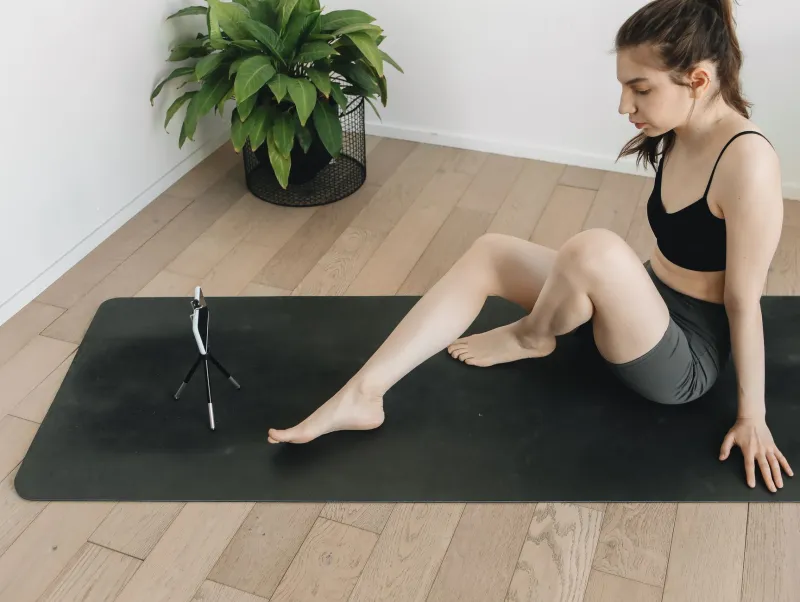
Let's be honest — at some point, most of us have propped a phone against a water bottle, hit record, and knocked out a set hoping it looked as good as it felt. Maybe you wanted to check your form. Maybe you wanted to post it. Maybe both. No judgment here.
But there's a growing body of evidence — both from sports psychology research and from coaches who work with real people in real gyms — suggesting that the habit of filming workouts isn't as neutral as we assume. When documentation becomes a regular part of your training routine, something subtle but significant starts to shift. And it's not shifting in your favor.
Your Brain Can Only Focus on One Thing at a Time
Here's the core issue: effective lifting demands internal focus. When you're squatting heavy, your attention should be on bracing your core, driving your knees out, keeping your chest up, and hitting depth. That's a lot of mental real estate to manage simultaneously.
Now add a camera to the equation. Suddenly part of your brain is asking a completely different set of questions — Is the angle right? Can you see my back? Does this look impressive? That shift from internal cues (what your body is doing) to external cues (what your body looks like) is called an attentional focus switch, and research consistently shows it degrades movement quality.
A study published in the Journal of Motor Behavior found that athletes who focused internally on their own movement mechanics performed better and with greater consistency than those focused on external outcomes. Filming, almost by definition, pushes you toward the external. You're performing for something outside yourself rather than training from within.
The Biomechanics of Performing for a Camera
Coaches have started noticing a specific pattern in clients who film frequently: they unconsciously alter their movement to look better on screen rather than to move better in practice.
Common compensations include:
- Cutting depth on squats because a slightly higher squat looks more loaded and powerful in video
- Flaring elbows on bench press because it makes the chest look wider in the frame
- Rushing through the eccentric phase of a deadlift because slow lowering looks less dramatic than a fast pull
- Choosing a camera angle that flatters the lift rather than one that would actually reveal form breakdowns
None of these are conscious decisions. That's what makes them dangerous. You're not deliberately sandbagging your training — your nervous system is just quietly optimizing for the camera's approval instead of mechanical efficiency. Over weeks and months, these small compensations compound. What started as a minor tweak to look better on video becomes a deeply ingrained movement pattern that puts you at real risk for injury.
The Psychological Trap Nobody Talks About
Beyond the biomechanics, there's a mental game being played every time you hit record. Training for content and training for results are fundamentally different psychological states, and mixing them in the same session creates friction that most people don't even notice.
When you're training for results, a failed rep is data. It tells you something about where you are and what needs work. When you're training for content, a failed rep is a problem — it's unusable footage, it's potentially embarrassing, it might make you look weak. So you start unconsciously selecting weights and exercises that photograph well rather than weights and exercises that challenge you appropriately.
This is sometimes called impression management, and it's a well-documented phenomenon in social psychology. We modify our behavior when we believe we're being observed or recorded. The issue is that your gym sessions are supposed to be the one place where you can fail safely, push into discomfort, and make ugly progress. The camera disrupts that psychological safety net.
So Should You Never Film Yourself?
Not at all. Video feedback is genuinely one of the most useful tools in a lifter's toolkit — when used intentionally. The difference is why you're filming and what you do with the footage.
Filming a set to review your squat depth after the session? That's smart training. Filming a set because you want to post it before you've even cooled down? That's content creation, not training — and there's nothing wrong with content creation, but it shouldn't be disguised as a training tool.
Here are a few practical ways to keep video useful without letting it run your session:
1. Separate your review sets from your working sets. If you want to check your form on video, designate a specific set for that purpose — usually a lighter warm-up or technique set. Don't film your heaviest working sets unless you genuinely need the footage for coaching feedback.
2. Review the footage after your workout, not between sets. Watching video between sets pulls you out of the training mindset and into an editorial one. Let the session be the session.
3. Ask yourself why before you hit record. If the honest answer is "because it'll make a good post," that's fine — just acknowledge it. Film it, post it, and then put the phone away and train the rest of your session without the camera.
4. Use a coach or training partner for form checks instead. A good pair of eyes in real-time will always beat a camera angle for catching movement flaws. If you don't have access to a coach, consider booking even a single session with a qualified trainer to audit your technique on your key lifts.
5. Go phone-free for at least one training block per month. Pick a two- to four-week training block where you commit to zero filming. Notice how your focus changes. Notice whether you push harder, whether you're more willing to fail, whether your sessions feel different. Most people who try this report that their training feels sharper almost immediately.
The Bigger Picture
None of this is an argument against social media or against sharing your fitness journey. Fitness communities online can be genuinely motivating, and there's real value in connecting with people who share your goals. The problem isn't the camera — it's letting the camera become the point.
At GymSRV, we're pretty firm on one thing: your training should serve your body, not your feed. The gains you're chasing don't care how many views your deadlift video gets. They care about progressive tension, clean mechanics, and consistent effort over time.
Film when it helps you train better. Put the phone down when it doesn't. That's really the whole playbook.