You're Training for the Reflection, Not the Result — Here's Why That's Holding You Back
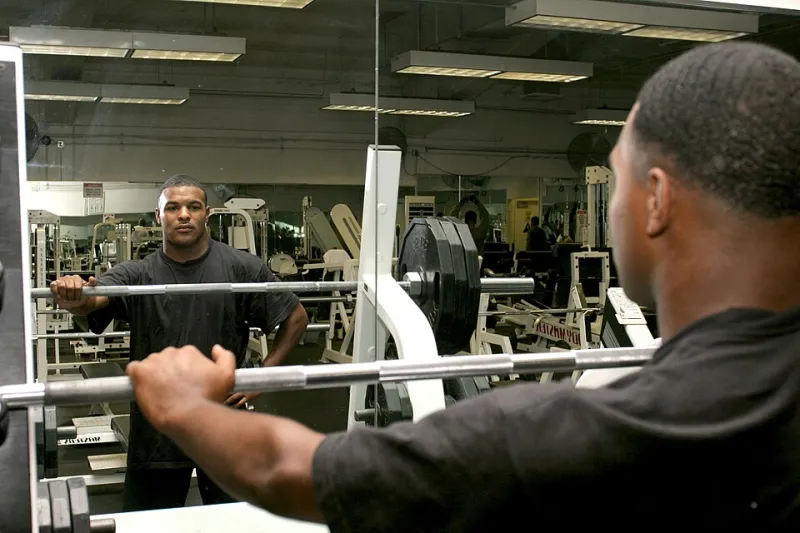
Photo: Unknown, Public domain, via Wikimedia Commons
The Mirror Is Lying to You (And You Keep Asking It Questions)
Walk into any commercial gym in America and you'll see the same scene play out: someone finishes a set of curls, drops the dumbbells, and immediately locks eyes with their reflection. They flex. They tilt slightly. They decide whether the workout is "working" based on what they see in the next three seconds.
This is the mirror trap — and it's quietly sabotaging more training programs than any bad exercise choice ever could.
Gym mirrors aren't inherently evil. They serve a real purpose: helping you monitor posture, verify joint alignment, and catch form breakdowns before they become injuries. But somewhere along the way, mirrors went from being a coaching tool to being the primary feedback mechanism for millions of lifters. And that shift comes with some serious consequences.
The Pump Is Real — But It's Also Temporary
Here's the science behind what you're actually seeing when you check yourself out mid-workout. During resistance training, blood floods into the muscle tissue you're working. This temporary engorgement — the "pump" — makes muscles appear significantly larger and more defined than they are at baseline. It looks incredible. It feels incredible. And it disappears within about an hour of leaving the gym.
The problem is that pump aesthetics and genuine muscular development are not the same thing. A muscle that looks massive during a high-rep cable fly session isn't necessarily stronger or structurally larger than it was six weeks ago. The mirror can't show you myofibrillar hypertrophy — the actual increase in muscle fiber size driven by progressive mechanical tension. It can't show you improved neuromuscular efficiency. It can't show you that your posterior chain is finally firing the way it should.
What it can show you is blood volume. And blood volume is a terrible way to measure progress.
How Mirror Dependency Changes Your Training Decisions
When the reflection becomes your primary feedback loop, your exercise selection starts drifting in a predictable direction. You gravitate toward movements that produce the most visible pump — isolation exercises, cable work, high-rep finishers. You avoid the heavy compound lifts that build the most actual muscle because they're awkward to watch yourself do, and the post-set result doesn't look as dramatic in the mirror.
Squats? Hard to see your legs properly. Deadlifts? You're staring at the floor. Heavy rows? Your back is facing away from the glass. Meanwhile, the dude doing preacher curls in front of the mirror for 45 minutes looks absolutely jacked while he's doing it, so his approach must be working, right?
This is how aesthetics-chasing quietly displaces performance-based training. You start programming around what looks good mid-rep rather than what produces results over months.
There's also a psychological component worth talking about. Research in body image and exercise behavior consistently shows that mirror-focused training environments can increase appearance anxiety — particularly for people who are already prone to comparing themselves to others. When your main progress metric is a reflection surrounded by other people's reflections, you're setting yourself up for a distorted sense of where you actually stand.
What Actually Measures Progress
The antidote to mirror dependency isn't smashing every reflective surface in the gym. It's replacing a bad feedback system with better ones. Here's what real progress actually looks like when you're paying attention to the right signals:
Strength numbers. If you squatted 185 pounds for five reps in January and you're squatting 225 for five reps in April, you built muscle. Full stop. The barbell doesn't care how pumped you looked doing it.
Movement quality. Can you hit deeper range of motion than you could three months ago? Are your joints tracking better? Is a movement that used to feel clunky starting to feel smooth? These are signs your body is adapting — and they're invisible in the mirror.
Performance benchmarks. Track your work capacity. How many pull-ups can you do? How fast does your heart rate recover between sets? These metrics tell a story the mirror never could.
Progress photos — on your terms. If visual feedback matters to you, take consistent photos under consistent lighting at consistent times of day. This removes the pump variable and gives you an actual before/after comparison over weeks and months, not the distorted snapshot you get mid-session.
Try Going Dark
One of the most eye-opening things you can do for your training mindset is deliberately work out without mirrors for two to four weeks. This isn't some ascetic challenge — it's a recalibration exercise. Many lifters find that when they remove the visual feedback loop, they naturally shift their focus inward: to how the movement feels, where the tension is, whether their breathing is controlled.
This is called proprioceptive training — relying on your body's internal sense of position and movement rather than external visual confirmation. Athletes and coaches have used it for decades. It sharpens mind-muscle connection in a way that staring at your reflection simply can't.
If your gym layout allows it, try turning your back to the mirrors for compound movements. Face the wall. Face a window. Focus on the sensation of the lift rather than the optics of it.
Use Mirrors Like a Tool, Not a Trophy Case
None of this means mirrors have no place in your training. They absolutely do — especially for beginners learning movement patterns, or for anyone working through a technical lift where visual feedback helps reinforce proper mechanics.
The goal is intentionality. Use the mirror to check your knee tracking during a squat. Use it to verify your spine is neutral during a Romanian deadlift. Use it to confirm your shoulder isn't creeping up toward your ear during a lateral raise. Then look away and feel the rest of the set.
When you stop training for the reflection and start training for the result, something shifts. The workouts stop being performances and start being investments. And investments — unlike pump aesthetics — compound over time.
That's what GymSRV is all about: training smarter so you can live stronger. The mirror's a tool. Don't let it be your coach.